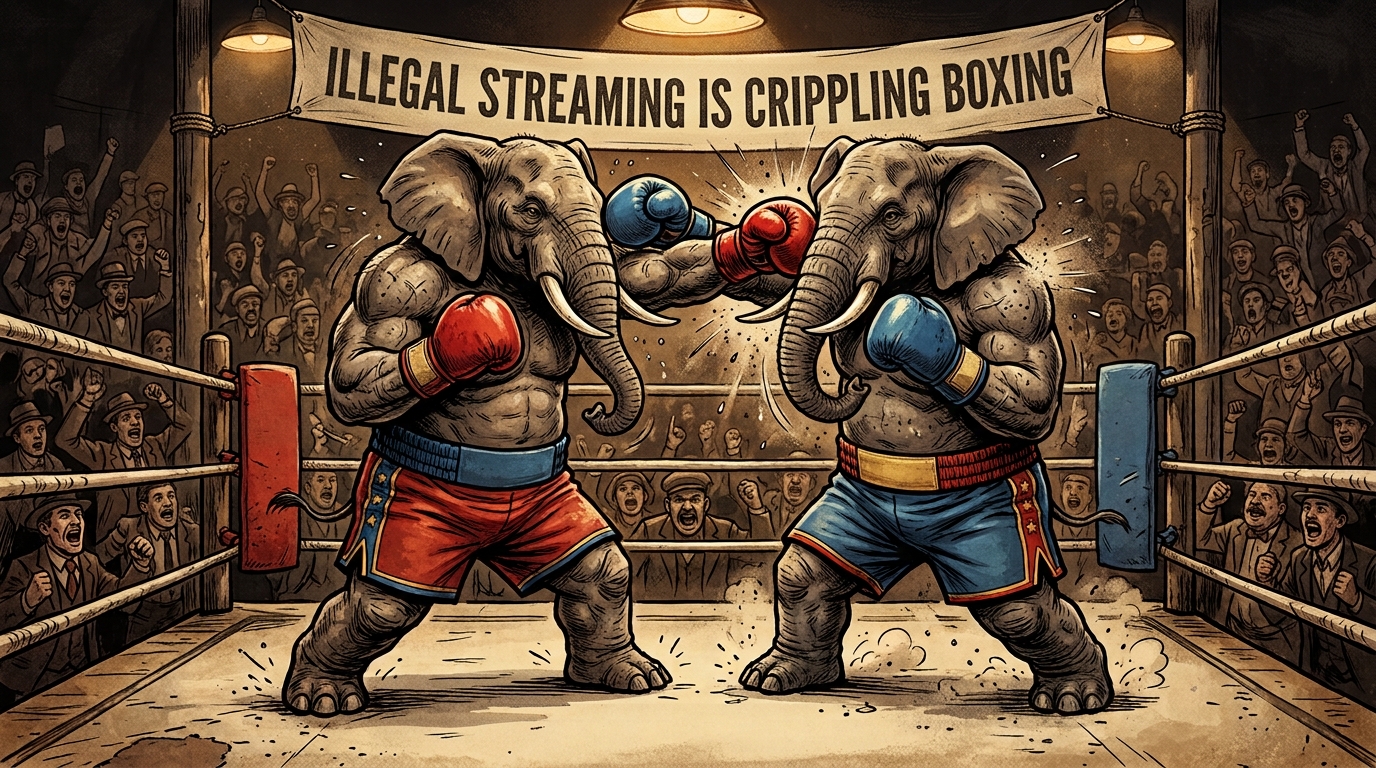
Piracy – The Elephant in The Boxing Room
Article by Joseph Herron of War A Week Boxing
Boxing has spent years arguing about promoters.
It has argued about networks.
It has argued about broadcasters, sanctioning bodies, managers, fighters, promotional rivalries, inflated purses and the endless inability to make the fights fans actually want to see.
But perhaps the biggest problem confronting the sport is something much less visible.
It is sitting in millions of living rooms, on millions of phones, tablets and televisions, and it is increasingly being treated as though it is perfectly normal.
Piracy.
The timing could hardly be more important.
Only days ago, Hamzah Sheeraz voluntarily relinquished the WBO super middleweight championship rather than proceed with his mandatory defense against Janibek Alimkhanuly. Queensberry Promotions had won the purse bid with a $1,001,809 offer, which under the WBO’s 75/25 split would have paid Sheeraz approximately $751,357 and Alimkhanuly approximately $250,452. Sheeraz ultimately chose not to proceed.
There are multiple factors behind that decision, including Sheeraz’s objections to Alimkhanuly being installed as mandatory challenger and the enormous difference between that purse and the money Sheeraz has become accustomed to earning on Riyadh Season cards. It would therefore be irresponsible to claim that piracy caused Sheeraz to vacate his title.
But his situation illustrates the larger economic distortion facing boxing.
And that distortion leads to a much bigger question:
Where does boxing’s real market value come from when a massive portion of the audience can consume the product without paying for it?
For generations, promoters understood something fundamental.
The fans were the bosses.
Their money determined what worked.
Their enthusiasm determined what sold.
Their willingness to purchase tickets, pay-per-views and subscriptions helped determine the value of fighters and the size of purses.
But the digital revolution changed that equation.
Suddenly, a fan could love boxing, desperately want to watch the biggest fight of the year—and still decide not to pay for it.
Instead, an unauthorized high-definition stream could appear on a website, social platform, IPTV service or messaging channel.
And the customer could watch.
For free.
The scale of the problem is no longer theoretical.
Ampere Analysis reported that 69% of U.S. sports fans pirated live sports at least once a month, up from 62% the previous year. Nearly half of those sports pirates cited cost-related reasons, while almost one-third said they already paid for a legitimate sports service but did not want another subscription.
That statistic should stop the entire sports-media industry in its tracks.
And it should be especially alarming to boxing.
Because boxing is not the NFL.
It is not the NBA.
It is not Major League Baseball.
Those sports have enormous domestic audiences, massive long-term media-rights contracts, extensive advertising ecosystems, corporate partnerships and revenue streams that can absorb enormous financial shocks.
Boxing is a fragmented sport built around individual events.
The economic model is far more dependent upon the ability to monetize individual fights.
And that makes piracy particularly destructive.
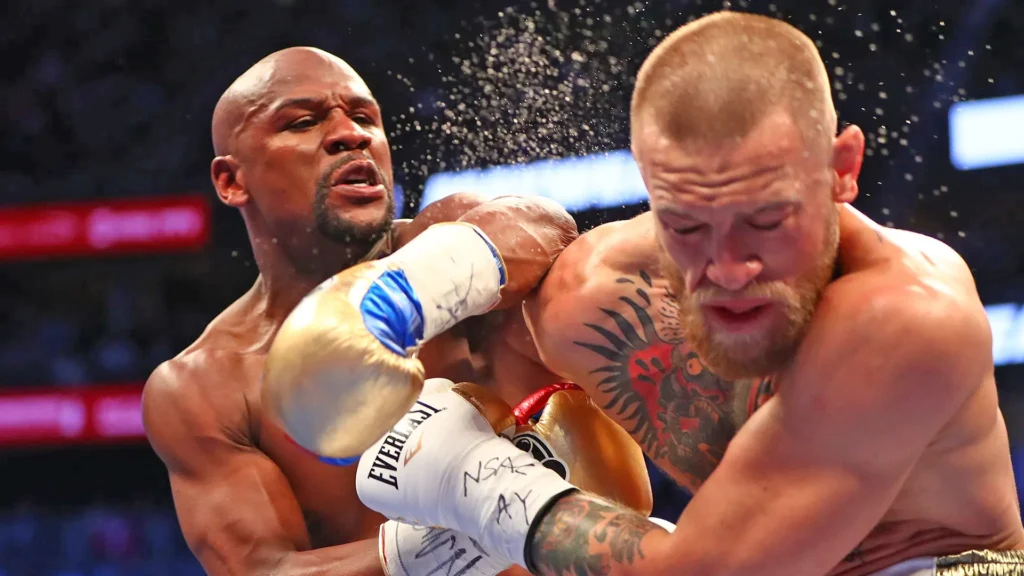
Despite the success of Mayweather vs McGregor, nearly 3 million viewed the fight illegally.
The U.S. Trade Representative’s 2025 review of sports piracy explained why. Unlike movies or television programs, whose commercial value can survive for months or years, live sports derive much of their value from real-time viewing. Once the fight is over, the primary commercial window is gone. A pirate stream that steals an audience during those few hours cannot simply be recovered the next day.
Boxing has been demonstrating this problem for years.
Mayweather-McGregor in 2017 generated approximately 2.93 million viewers across 239 illegal streams, according to Irdeto.
Wilder-Fury in 2018 was estimated by MUSO to have attracted nearly 10 million unauthorized viewers worldwide, including approximately 1.9 million in the United States.
Then came Joshua-Ruiz in 2019.
More than 13 million unauthorized viewers were estimated worldwide.
The United States alone accounted for more than 600,000.
That number exceeded the piracy audience MUSO had previously tracked for Wilder-Fury and became the largest unauthorized boxing audience the company had recorded at the time.
This is not a new problem.
It is an old problem that has become technologically easier, socially normalized and vastly more sophisticated.
And there is another uncomfortable reality.
The pirates are not necessarily people who hate boxing.
Many are passionate boxing fans.
That is what makes the problem so complicated.
They want to see the fights.
They talk about the fighters.
They argue about rankings.
They complain when the best fighters don’t face one another.
They demand better matchmaking.
They want the sport to thrive.
And then some of those same fans still find an illegal stream when the bill arrives.
That creates a contradiction the boxing industry can no longer afford to ignore.
Fans have every right to criticize boxing.
They have every right to complain about $80 or $100 pay-per-views.
They have every right to complain about fragmented streaming services, excessive subscriptions, poor matchmaking and cards that do not justify their price.
The industry must listen.
But criticism of the product does not create a license to steal the product.
And this is where accountability has to go both ways.
Promoters have responsibilities.
Networks have responsibilities.
Fighters have responsibilities.
Managers have responsibilities.
And fans have responsibilities too.
The fan is still the most important person in the boxing economy.
But being the boss of boxing does not mean demanding a product while refusing to participate financially in the system that produces it.
There is a painful irony here.
Fans have spent years saying, correctly, that promoters need to give them the fights they want.
But when the industry produces those fights and a significant portion of the audience consumes them illegally, the economic data used to justify future investment becomes distorted.
How does a promoter accurately determine the market value of a fighter when millions of people are watching but only a fraction are paying?
How does a network determine what rights are worth when the measurable audience does not represent the actual audience?
How does a promoter justify paying a fighter $5 million, $10 million or more when the legitimate revenue generated by the event cannot support that purse?
And how does the industry prevent fighters from becoming accustomed to purses that are disconnected from the revenue their fights can realistically generate?
This brings the conversation back to inflated purses.

Turki Alalshikh has been involved in boxing for three years, and has impacted the financial side of the sport significantly.
The arrival of Saudi Arabia and Turki Alalshikh has unquestionably produced major fights and career-high paydays. ESPN reported that the first Fury-Usyk event generated more than $50 million in PPV revenue, more than $40 million in sponsorship revenue and over $3 million in ticket sales, while the overall event cost was estimated at roughly $120 million.
That does not mean piracy caused Saudi Arabia to spend that money.
It did not.
The Saudi investment is part of a much broader strategy, and Turki Alalshikh has repeatedly demonstrated a willingness to spend enormous sums to make fights that traditional boxing economics struggled to produce.
But it does demonstrate the fundamental problem.
The amount of money required to stage elite boxing has increasingly become disconnected from the amount of money the traditional boxing marketplace can reliably generate.
And piracy makes that problem worse.
When legitimate customers disappear from the revenue side while fighter expectations rise on the expense side, somebody eventually has to absorb the difference.
Sometimes it is a promoter.
Sometimes it is a network.
Sometimes it is a wealthy benefactor.
Sometimes it is an investor willing to subsidize the event.
But no business can depend indefinitely upon somebody else writing the check.
Eventually, the numbers matter.
And this is where the boxing fan has to look in the mirror.
It is easy to say that promoters are destroying boxing with inflated purses.
It is easy to say that fighters are greedy.
It is easy to say that networks are charging too much.
It is easy to say that Saudi money has distorted the market.
But if a substantial percentage of the audience is simultaneously consuming the product without paying for it, the problem is much bigger than any one promoter, network, fighter or benefactor.
The economic foundation itself has been compromised.
There is another important piece of evidence that should not be ignored.
The European Union Intellectual Property Office reported that 12% of EU citizens had accessed sports content from illegal online sources, with the number rising to 27% among people aged 15–24.
And the problem continues to evolve.
In its monitoring of live-event piracy, EUIPO reported that visits to piracy websites offering unauthorized retransmissions rose to more than 0.8 average monthly visits per internet user in February-March 2025. More than 27 million notices were submitted to intermediaries during the monitoring period, yet only about 11% resulted in suspension of the unauthorized retransmission during the event.
This is not simply a boxing problem.
It is a global sports-media problem.
But boxing may be particularly vulnerable because it lacks the financial infrastructure enjoyed by the biggest American sports.
And that brings the discussion back to the phrase that has defined boxing economics for generations:
The fans are the real bosses.
Yes.
But the boss has to pay the bill.
If fans want better fights, fighters must be paid.
If fighters must be paid, promoters must generate revenue.
If promoters need revenue, networks and streaming platforms must see value in purchasing the rights.
If networks are going to pay substantial rights fees, advertisers and subscribers must have economic value.
And if that entire chain is repeatedly bypassed by piracy, eventually the money at the bottom of the pyramid begins to disappear.
That does not absolve promoters.
It does not absolve networks.
It does not absolve fighters.
And it certainly does not mean every price is justified.
The industry must make its product more accessible, more compelling and more worthy of legitimate payment.
The fragmentation of sports media is a real issue. Ampere found that 47% of sports fans globally feel overwhelmed by the number of online services they have access to, while 51% said they would pay extra to access all their favorite sports in one place.
That is an important message for the industry.
Make it easier to buy the product.
Make it affordable.
Make the fights matter.
Make the customer feel valued.
But once those things are done, the customer has to hold up his or her end of the bargain.
Because there is a fundamental difference between being dissatisfied with a product and stealing it.
Boxing cannot survive forever on passion alone.
Passion has to become participation.
The industry cannot continue pretending that millions of illegal viewers are equivalent to millions of paying customers.
They are not.
And the industry cannot continue pretending that the money required to produce the fights can simply grow forever while the legitimate paying audience shrinks.
It cannot.
Perhaps this is the uncomfortable conversation boxing desperately needs.
The sport does not merely have a promoter problem.
It does not merely have a fighter problem.
It does not merely have a network problem.
It has a business-model problem.
And piracy sits directly in the middle of it.
The answer is not to crucify the fighters.
The answer is not to demonize Turki Alalshikh for trying to give boxing the fights fans demanded.
The answer is not to blindly defend promoters and networks.
And it certainly is not to pretend the fans bear no responsibility.
Everyone who loves boxing has a role to play in preserving it.
Promoters must produce meaningful fights.
Networks must create sustainable platforms.
Fighters must understand that championship belts and meaningful competition cannot become secondary to guaranteed money.
Benefactors must recognize that unlimited subsidies can distort the marketplace.
And fans must recognize that supporting boxing means more than watching it.
It means supporting the legitimate product when the product is worth supporting.
Because if the people who claim to love boxing continue to consume it without financially supporting it, eventually the sport may discover a painful truth:
The biggest threat to boxing may not be that the fans stop watching.
It may be that they keep watching—but stop paying.
And when that happens, the question is no longer whether boxing has enough fans.
The question becomes whether it has enough paying fans to sustain the boxing those fans say they love.
That is the real fight now.
And unlike any fight inside the ring, there may be no benefactor rich enough to carry boxing forever.
Joseph Herron is the host of War A Week Boxing, a podcast that is featured on YouTube. He has been involved with boxing for over 30 years.