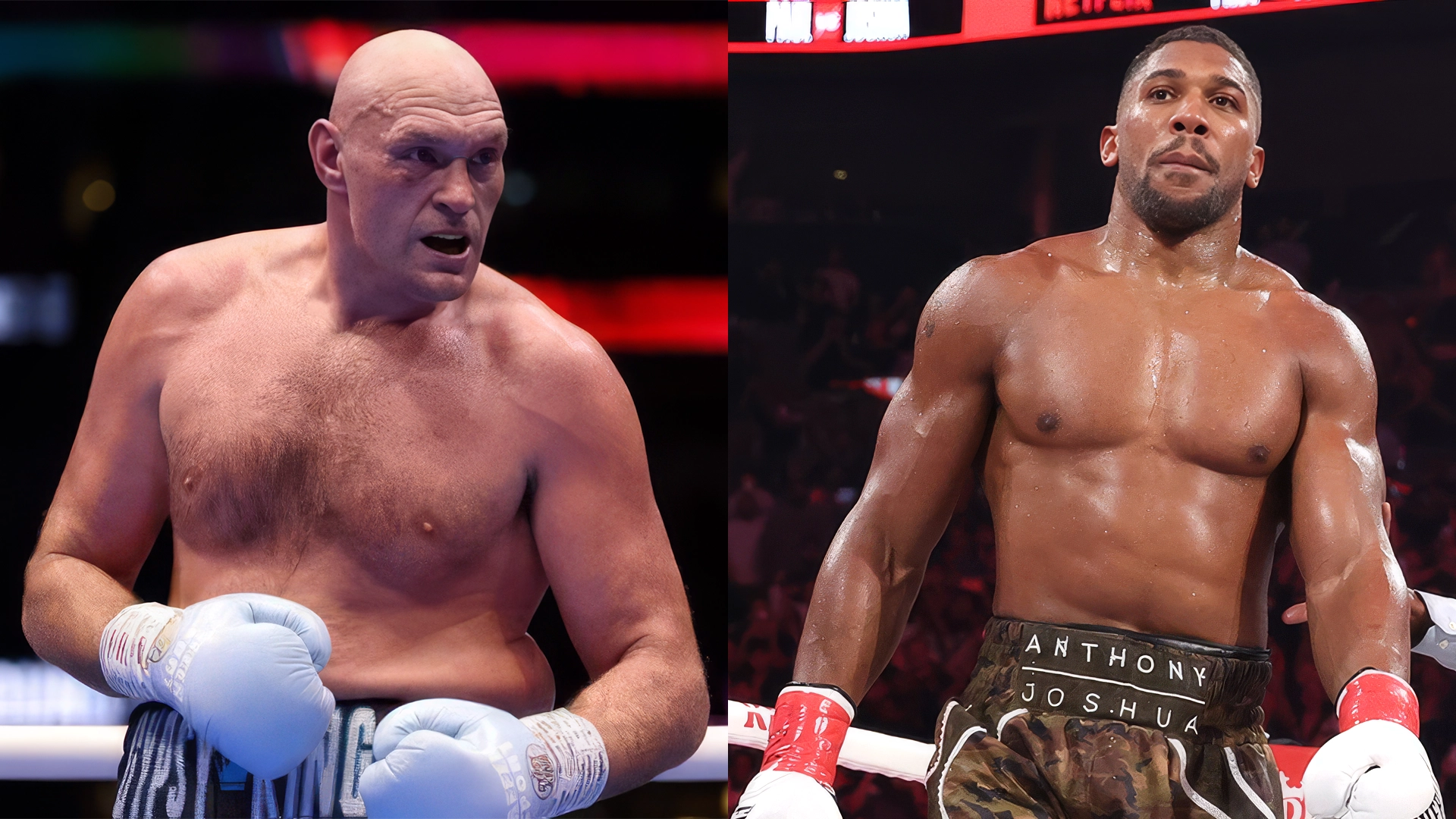
Fury vs. Joshua: Boxing Can’t Afford to Screw This One Up
Article by Joseph Herron of War A Week Boxing
There is an old adage in the boxing business that seems to resurface whenever the sport has an extraordinary opportunity placed directly in front of it:
Boxing just can’t seem to stay out of its own way.
Unfortunately, the ongoing saga surrounding the proposed Tyson Fury–Anthony Joshua showdown may become the latest and perhaps most painful example.
Because this time, the stakes extend far beyond two heavyweight stars finally settling unfinished business.
This time, the future of boxing’s relationship with the American mainstream may be hanging in the balance.
Unlike virtually every other major professional sport, boxing has no central commissioner or governing authority capable of looking at the entire industry and asking one fundamental question:
What is best for boxing?
Instead, the sport is comprised of thousands of individual interests, each with its own fighters, promoters, managers, contracts, broadcast relationships and financial objectives.
There is no commissioner sitting above the entire operation with the authority to say, “Enough. This event is too important to allow the business to destroy it.”
It is the Wild West.
Everyone has an agenda.
Everyone has a preferred outcome.
And everyone has a financial interest.
That fragmented structure is one of the reasons boxing has struggled to establish a consistent presence in the American mainstream.
For years, the sport has attempted to find a major American media partner capable of bringing boxing back into the living rooms of casual sports fans.
Now, perhaps the biggest entertainment platform in the world has come knocking.
Netflix.
And that is what makes the current situation so extraordinarily frustrating.
Netflix already has an established relationship with Tyson Fury through At Home with the Furys, and its interest in a Fury–Joshua event potentially gives boxing something it desperately needs: enormous mainstream exposure through a platform with extraordinary reach.
But here is the uncomfortable reality that everyone involved in this negotiation should understand:
Netflix doesn’t need boxing. Boxing needs Netflix.
That distinction cannot be overstated.
Joshua knocked out Jake Paul on Netflix last November.
Netflix can walk away from boxing and continue entertaining its global audience with movies, television, documentaries and other live sporting events.
Boxing cannot simply replace Netflix with another company possessing the same combination of reach, mainstream recognition and American penetration.
That makes Fury–Joshua much more than another heavyweight attraction.
It is a test.
Can boxing actually function as a viable business partner for a mainstream American entertainment company?
Or will the sport once again allow competing interests to turn an extraordinary opportunity into an unnecessary mess?
The current dispute has reportedly centered heavily around the location of the event.
Joshua’s side has maintained that his contractual position requires the fight to take place in the United Kingdom, while Saudi organizers and Netflix have favored an American venue, with Madison Square Garden emerging as a preferred destination. Eddie Hearn has continued to advocate for Wembley.
And now the situation has become increasingly complicated.
Tyson Fury has publicly declared the Joshua fight off and called for a third meeting with Oleksandr Usyk. Hearn, however, has continued to maintain that Fury–Joshua can still be made, particularly if the Wembley issue can be resolved.
This is where the business of boxing needs to take a step backward and look at the bigger picture.
Nobody is suggesting that contracts don’t matter.
Nobody is suggesting that fighters shouldn’t protect their financial interests.
Nobody is suggesting that promoters shouldn’t protect their businesses.
But there comes a moment when everyone involved has to recognize that the event itself is bigger than any individual participant.
Tyson Fury versus Anthony Joshua is one of those moments.
Two future Hall of Famers.
Two former heavyweight champions.
Two of the most recognizable British fighters of their generation.
A rivalry that has existed for years.
A fight that requires virtually no explanation to the casual sports fan.
And now an entertainment platform with the ability to introduce that rivalry to an enormous American audience.
This is exactly what boxing has been asking for.
So why does it feel as though boxing is once again making it unnecessarily difficult?
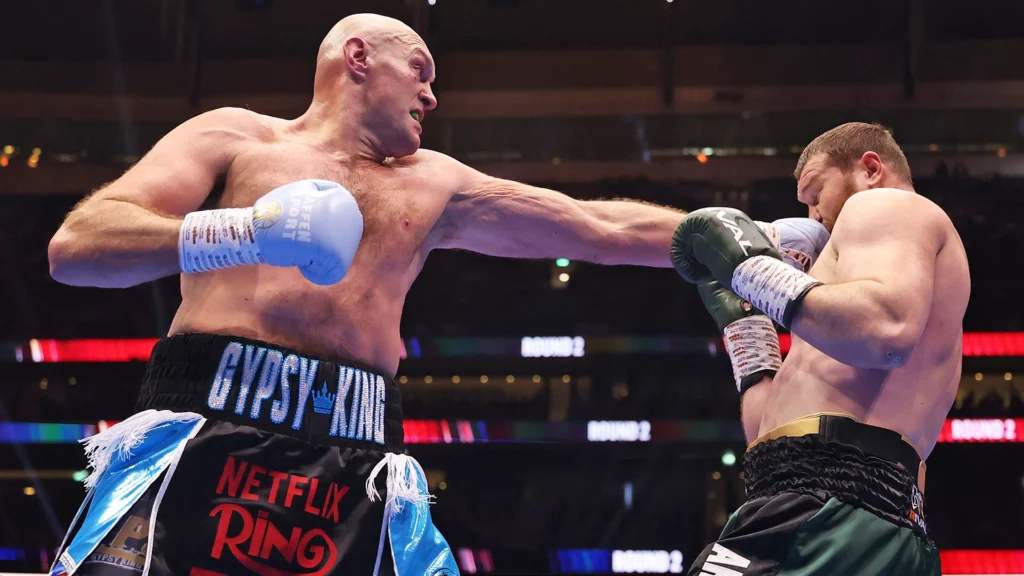
Fury beat Arslanbek Makhmudov April 11th on Netflix.
Perhaps the most frustrating aspect is that neither Fury nor Joshua needed this fight to become wealthy.
They didn’t need one another to become famous.
They didn’t need one another to build Hall of Fame résumés.
Both men have already accomplished extraordinary things independently.
But that is precisely why the fight became so valuable.
There is only one question that remains unanswered.
Who is better?
For years, boxing fans have waited for the opportunity to find out.
And now, as both men approach the twilight of their careers, the window is beginning to close.
Joshua’s recent fight with Kristian Prenga only added another layer of intrigue. Joshua was dropped twice in the opening round before recovering to stop Prenga in the second. It was an impressive recovery, but it also demonstrated that the former champion is not invulnerable and that every remaining chapter of his career carries genuine risk.
Fury, meanwhile, appears increasingly unwilling to sit around indefinitely waiting for the Joshua negotiations to resolve themselves.
That is why the possibility of Fury–Usyk III has become more than idle speculation.
Fury himself has called for it.
Usyk’s side has rejected the proposal for now, meaning the trilogy is not presently a completed agreement.
But should Fury–Joshua ultimately collapse, Fury–Usyk III could become the logical alternative.
And that would be an extraordinary conclusion to an extraordinary career.
It just wouldn’t be the conclusion boxing has been waiting for.
The prediction from this corner is that Fury–Usyk III ultimately gets made if Fury–Joshua cannot be rescued.
That is not necessarily what fans want to hear.
It certainly isn’t what the majority of boxing fans have been waiting nearly a decade to see.
But sometimes the professional obligation is to deliver the news as it appears rather than the news everyone hopes to hear.
And if Fury–Usyk III becomes reality, there is another fascinating possibility.
With Netflix already having built an entertainment relationship around Fury and At Home with the Furys, a third season could provide the backdrop for what would be an almost surreal conclusion to the Tyson Fury era.
Fury–Usyk III as the Season 3 finale.
It would be spectacular television.
It would undoubtedly be a major boxing event.
And yet it would also represent a tremendous missed opportunity.
Because the fight that could potentially introduce boxing to millions of new American viewers would not be Fury versus Joshua.
It would be Fury versus a man who has already beaten him twice.
That isn’t necessarily bad for boxing.
But it isn’t the opportunity sitting on the table today.
And that is why this situation matters so much.
The boxing business has spent years wondering why major American entertainment companies have been reluctant to invest heavily in the sport.
Perhaps part of the answer is painfully obvious.
If a company such as Netflix steps into boxing and immediately encounters competing promotional interests, contractual disputes, disagreements over venues and uncertainty over whether the event can even be delivered as envisioned, why would it want to do it again?
That is the question that should keep everyone involved awake at night.
Because Netflix doesn’t need boxing to flourish.
Boxing needs Netflix.
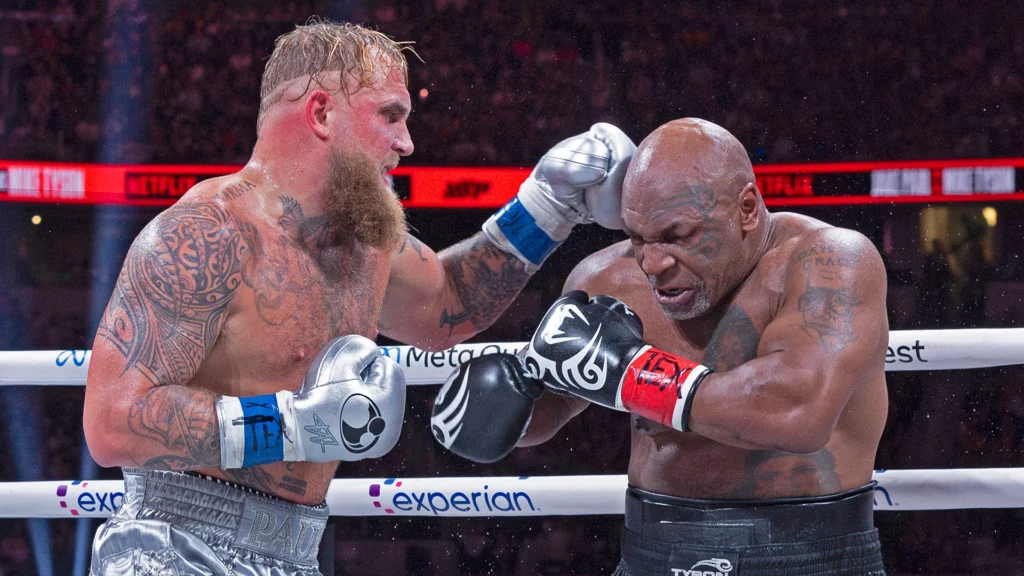
Jake Paul vs Mike Tyson was seen by 60 million people on Netflix.
The sport needs mainstream American exposure.
It needs new fans.
It needs younger fans.
It needs major entertainment companies to believe that boxing can be a reliable, commercially viable live-sports property.
And right now, one of the world’s largest entertainment companies has demonstrated an interest in giving boxing precisely that opportunity.
The industry cannot afford to teach Netflix the wrong lesson.
This should not be about Matchroom.
It should not be about Queensberry.
It should not be about Zuffa.
It should not be about who gets the biggest promotional credit.
It should not even be about Wembley versus Madison Square Garden.
Those are all important business considerations.
But they are secondary to the larger question:
Can everybody involved put the health of boxing ahead of their individual interests long enough to make the fight?
Because there may never be another opportunity quite like this.
The heavyweight division has provided boxing with some of its greatest stars.
Fury and Joshua are two of them.
The fans have waited.
The platform is interested.
The audience is there.
The fighters are approaching the end of their careers.
The moment has arrived.
And yet boxing appears dangerously close to doing what boxing has done so many times before.
Getting in its own way.
Boxing cannot afford to screw this one up.
Not this fight.
Not this platform.
Not this audience.
Not this opportunity.
Because if Tyson Fury and Anthony Joshua never share the ring, the sport will survive.
But if boxing repeatedly demonstrates to mainstream American entertainment companies that its own internal business structure makes the biggest events unnecessarily difficult to deliver, the consequences could extend far beyond one heavyweight fight.
The sport doesn’t need another reason for mainstream America to look elsewhere.
It needs a reason to come back.
Netflix may have just given boxing that reason.
Now the question is whether boxing will be wise enough to take it.
Joseph Herron is the host of War A Week Boxing, a podcast that is featured on YouTube. He has been involved with boxing for over 30 years.